
Searching Catoosa County Criminal Dockets
Start with the free Catoosa Tyler CM Web Search. No account is needed. You can search by party, associated party, or pieces of a case number, and two letters are enough to begin a party search. Pick ST for State Court or SU for Superior Court, then choose the criminal division. Filtering by filing date or active and inactive status trims long lists of court records fast.
Have a notice with a case number? Use its exact year and sequence. The portal splits those values apart even when an LMJC calendar prints them combined, like YYYY-SU-CR-NNN. Blank results usually mean a stale filter, a misspelled name, or the wrong court code. Try each fix in turn. Note that the portal itself warns accuracy is not guaranteed, so treat a docket hit as a lead worth confirming with the clerk.
- Confirm whether the matter is felony, misdemeanor, county traffic, or a city citation.
- Choose the State or Superior court code and criminal division.
- Search by year and sequence, or test the party-name spelling.
- Compare the register's next setting with the newest court calendar.
- Call the responsible clerk when the sources conflict.
Catoosa Felonies Start in Superior Court
Felony cases belong to Superior Court. That court is part of the Lookout Mountain Judicial Circuit, as the Catoosa County Courts department explains. Tracy Hullender Brown, the State/Superior Court Clerk, keeps the case register. The District Attorney prosecutes. A felony calendar can list the case number and counts. Offense labels, counsel or bondsman fields, times, and the judge assigned may appear too.
A docket is not a jail log or a statewide criminal history. Those answer different questions entirely. A Catoosa County criminal docket shows only what the court indexed and scheduled. So a charge line proves a filing and nothing more. It is never a conviction.
Inside a Catoosa County Criminal Docket
Think of the docket as a timeline. The court and case number come first. From there, separate filed events from scheduled ones, because a calendar entry only proves a hearing was planned. To learn what the court actually did, check the register or the later order.
| Case identity | Court code, criminal division, filing year, and sequence. |
|---|---|
| Charge or count | The accusation as indexed, not a final finding. |
| Setting | Date, time, judge or court, and calendar type. |
| Filing event | A motion, notice, order, plea entry, or other indexed act. |
| Disposition | The recorded outcome, checked against the signed order. |
Official criminal calendars carry more detail than the blank search form, including attorney and bondsman fields. Even so, one calendar snapshot never equals the full case file.
Catoosa State Court Criminal Path
Misdemeanors, county traffic cases, warrants, and preliminary hearings sit in Catoosa State Court, as its official State Court page describes. The Solicitor General handles the misdemeanor prosecutions and county-code violations. This court shares the clerk office and the Tyler portal with Superior Court. It just runs under its own code.
A citation written in Ringgold or Fort Oglethorpe may belong to municipal court instead. City records do not merge into Tyler just because both cities sit inside Catoosa County. Always read the citation for the issuing court before you search. That one habit prevents most blank results.
The clerk's official page is the source for this Catoosa County criminal docket image.
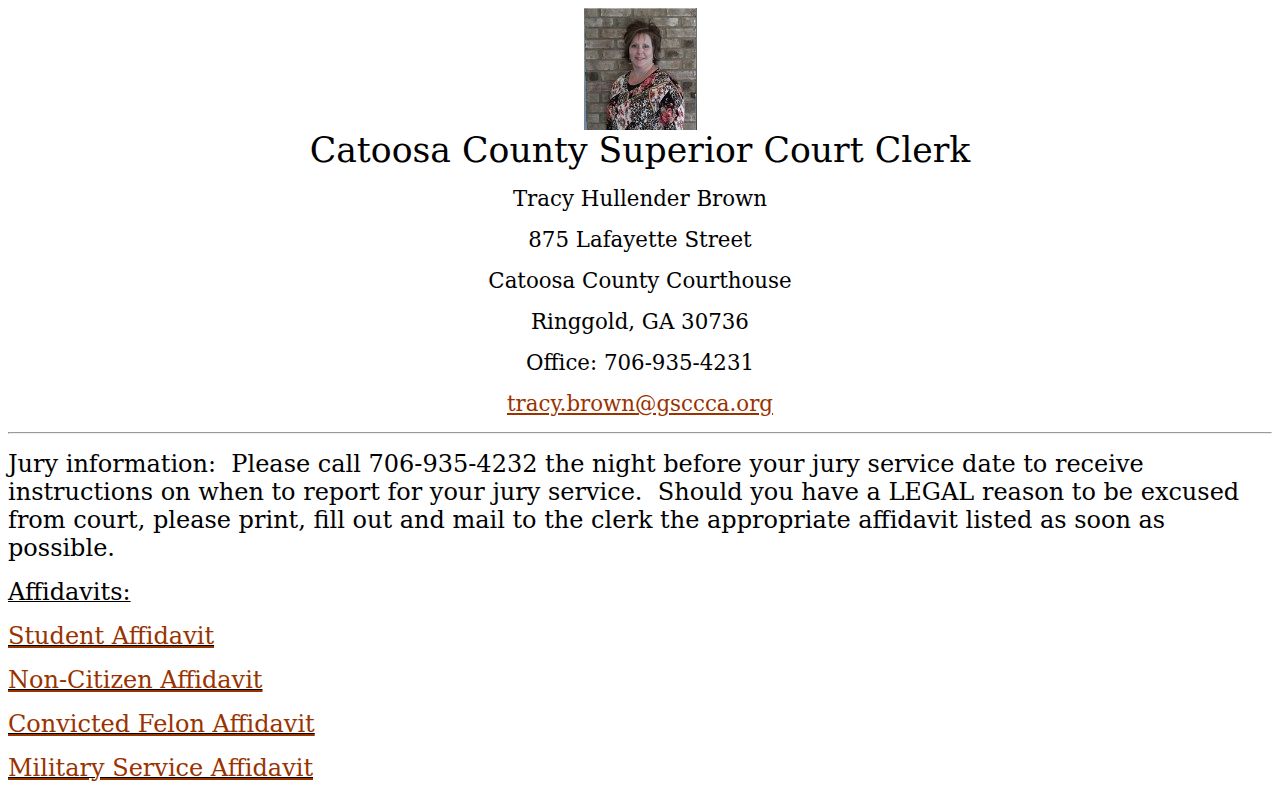
That page links the public register, calendars, PeachCourt, forms, and certified-record services through the local clerk.
How a Catoosa Criminal Case Moves
The sequence differs by case, but a criminal docket often follows this path: Filing → Arraignment → Pretrial or Motions → Plea or Trial → Disposition → Sentencing. Each label describes a step, not a result. Some cases end before trial. Others return for probation, bond, or post-judgment proceedings.
Each docket label means something specific. An arraignment is a formal appearance, and a motion setting deals with pending requests. Calendar calls track readiness. A plea setting leaves room for a plea. A criminal jury label marks a trial setting, not proof a trial happened. Grand jury, probation revocation, and bond forfeiture proceedings are each their own thing.
Catoosa Calendar Labels Need Context
Headings on the LMJC annual calendar include Criminal Motions, Criminal Status, Criminal Calendar Call, Arraignment, Pleas, Criminal Jury, Grand Jury, Bond Forfeiture, and Probation Revocations. A heading tells you why cases were set. It does not tell you the ruling.
- Calendar call
- A case-management or readiness setting before plea or trial.
- Disposition
- The recorded outcome, best checked against the final order.
- Continuance
- A court-approved move of a setting to another date.
- Probation revocation
- A proceeding on alleged probation violations, not a finding by its title.
Compact codes like CSRU and DA/NJ carry no official expansion on the calendar itself. Keep the label as printed, and ask the clerk what it means.
Courts That Hold Criminal Dockets
Catoosa County criminal records stay divided by court class. Felonies live in Superior Court. State Court holds county misdemeanors and traffic. Magistrate handles warrants and preliminary matters, Juvenile Court controls delinquency and juvenile traffic under tighter access rules, and Ringgold and Fort Oglethorpe each keep their own municipal dockets.
| Court | Scope | First route |
|---|---|---|
| Superior | Felonies | Tyler and LMJC calendars |
| State | Misdemeanors and county traffic | Tyler and State Court |
| Magistrate | Warrants and preliminary matters | Magistrate office |
| Municipal | City citations and ordinances | Issuing city clerk |
| Juvenile | Delinquency and juvenile traffic | Juvenile Court |
When Catoosa Search Shows No Data
A blank result proves very little. The case may still exist under a different court code, a different spelling of the name, or another court entirely, such as municipal, Magistrate, Juvenile, appellate, or federal. Status and date filters can also hide a valid case.
After Tyler, compare the newest calendar. For State and Superior questions, call 706-935-4231 or visit the clerk at 875 Lafayette Street, Ringgold, and ask where an older file is held and whether a register or copy is available. The clerk posts no listed public terminal fee for criminal images.
Federal prosecutions belong to the Northern District, never the county docket. The Rome Division page is the source for this Catoosa County criminal record image.
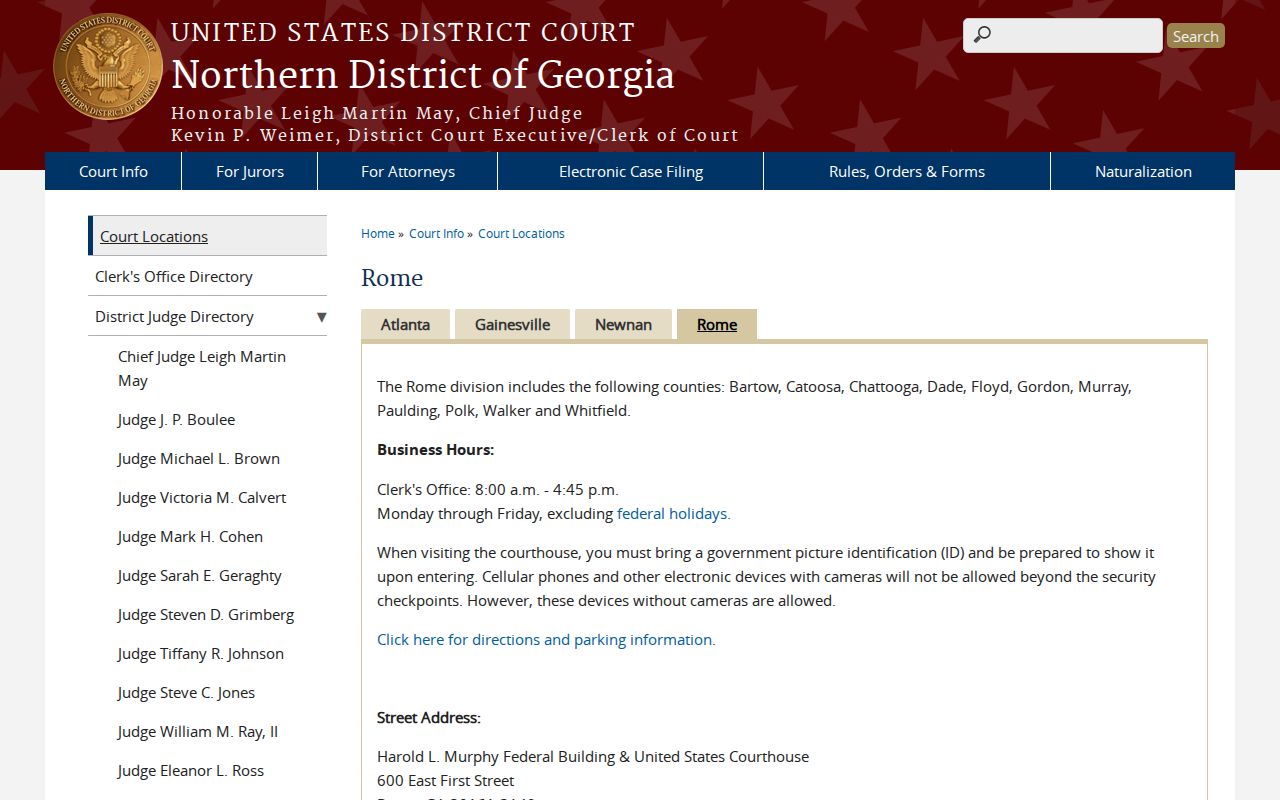
Federal lookup then runs through federal systems. Local State and Superior files stay with the county clerk.
Catoosa Criminal Files Beyond the Index
Think of Tyler as the index and PeachCourt as the filing counter. PeachCourt is the listed provider for Catoosa State and Superior Court documents. It requires an account, so it is not a free public docket search in the way Tyler is. Need the actual wording of an order, motion, or plea paper? Find the entry in Tyler first. Then ask the clerk which document route applies. That habit keeps every docket description tied to the filed paper itself.
A certified copy request works best when you are specific. Name the court, the case number, and the filing date if you know it. Say plainly whether you need certification. The clerk can walk you through delivery and payment steps. No flat fee covers all Catoosa County criminal records, so ask for a cost estimate before filing any broad request.
Sealed Dockets and Public Access
Adult Catoosa County criminal dockets are normally open to the public under Georgia court rules. Uniform Superior Court Rule 21 controls that access, within lawful limits. Some things stay closed no matter what. Protected identifiers, sealed material, grand-jury material, and juvenile records never become public just because a related hearing appears on the calendar. For restricting a record, Georgia record-restriction guidance explains the process under O.C.G.A. §35-3-37. Restriction is not the same as sealing a court docket. If part of a case is withheld, ask whether a redacted copy exists. Ask which rule or order controls it.
Access point: A missing Tyler result is not a seal indicator. Verify the court and indexing, then ask the custodian about restrictions.
When the record you want is not online, ask the right clerk for the specific register, motion, order, or disposition. Include the court, the case number, the date range, and your preferred format. If the online route comes up short, a written records request to the clerk is the fallback.